What can you make in 48 hours?
For Team 2.5 Brains 1 SD Card, the answer was a heist comedy about one sister stealing the other sister’s white tee.
The team was made up of UConn Digital Media & Design students in Stamford who took on the DMCT 48-Hour Film Challenge, Digital Media Connecticut’s short film challenge for Connecticut college students. Over a single weekend, they wrote, shot, and edited a film from scratch, working through audio problems, an edit that came down to the wire, and a tense final submission. Their film won “Best Fim” for the 48-Hour Film Category at our 2026 DMCT Awards.
Last year’s challenge ran from November 7th-9th and required teams to create a 1-3 minute film incorporating a required character name, prop, and line of dialogue of their choosing.
“It didn’t need to be complicated to be funny.”– Austin Kipput
Here’s how the team planned their 48 hours, the problems they ran into, and what they would tell students thinking about taking on the next challenge.
Ready to take on the challenge yourself? This year’s DMCT 48 Hour Film Challenge takes place on November 6th– 9th . Learn more & Register here: digitalmediact.com/48hourfilmchallenge/
Meet Team 2.5 Brains 1 SD Card
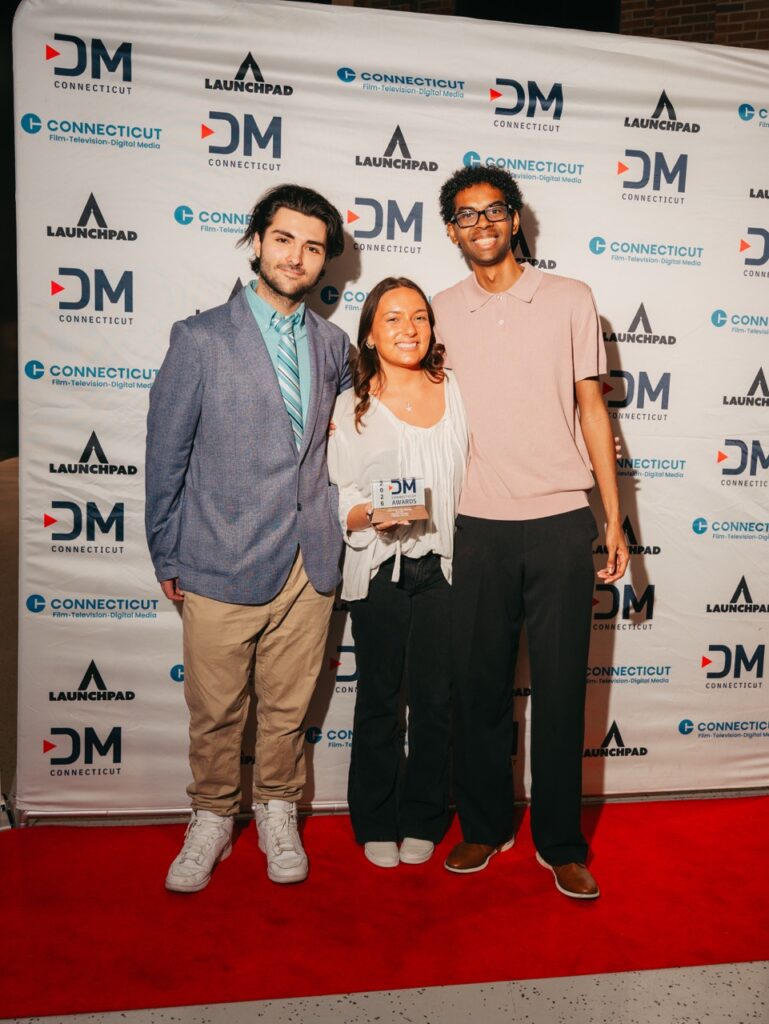
Tell us a little about your team. Who participated, and what did each person bring to the project?
[Shiloh Williamson]: Our team, 2.5 Brains 1 SD Card, was made up of myself, Shiloh Williamson, and my two incredibly talented peers and friends, Carly Clarke and Austin Kipphut! At the time of last year’s 48 Film Challenge, we were all students in the UConn DMD Program here in Stamford. On the project itself, I was the scriptwriter and makeshift producer. Austin and Carly collaborated on the visual style of the film, and Carly was our everything-in-one editor. It was a long but incredibly rewarding 2 days spent working on what we feel is a super funny, relatable heist comedy.
Three Phases, Two Days
A 48-hour deadline leaves little room for guessing, so the team planned their weekend around clear phases.
How did your team divide up the 48 hours?
[Carly Clarke]: Our team divided the project/days into three phases: pre-production, production, and post-production. On Friday, we focused on brainstorming ideas, writing and finalizing the script, and gathering any props we needed. The following day, we spent the entire day filming. We specifically chose to “shoot for the edit” to ensure a quicker and more efficient post-production process. On the final day, we focused on editing and gathering any necessary sound effects and voice-over assets.
Working Through the Hurdles
Even with a plan, the weekend did not go perfectly. For one team member, working through it together became the best part of the experience.
What was your favorite part of the creative process?
[Austin Kipput]: My favorite part was having fun with my group mates, Carly and Shiloh. We hit a lot of hurdles along the way, from audio problems to editing that came down to the wire to getting the final submission in, but we worked through every one of them together. Through all the blood, sweat, and tears, there wasn’t a dull moment, and the process was genuinely enjoyable for all of us. That matters most to me, because I think the people and connections are what make an experience, more than the experience itself.
It Didn’t Need to Be Complicated
The film’s premise fits in a single sentence, and one teammate says that is a big part of why it worked.
What are you most proud of about the finished film?
[Austin Kipput]: I’m most proud that it made us laugh. I usually hate the things I make. I want my work to be my absolute best, so I get too deep into criticizing it. But our group did a fantastic job making something I honestly couldn’t judge that way. Our short is about one sister stealing the other sister’s white tee, and I think that simplicity is a big part of why it works. It didn’t need to be complicated to be funny. Because it was supposed to be funny, and it actually was funny to us, we could enjoy and appreciate it for what it is, especially after everything it took to get it finished.
More Than a Class Project
Student filmmakers work on deadlines all the time, but a 48-hour challenge changes how creative decisions get made.
What did participating give you that you might not get from a traditional class project?
[Carly Clarke]: This project provided just the right amount of pressure to encourage me to take creative risks. I think with school projects, it’s easier to sit down and carefully plan out your approach. However, with such a tight time constraint, you’re pushed to try your first few ideas and see what works. I also believe this challenge emphasized the importance of adaptability. If something goes wrong, you have to quickly weigh your options, adjust your approach, and pivot when necessary.
Skills That Carry Over
One team member has already put the weekend’s lessons to work.
Why should someone participate in this challenge? What advice would you give next year’s participants?
[Shiloh Williamson]: As a recent UConn graduate now working at ITV America, I find myself constantly drawing on the skills I developed during the 48-Hour Film Challenge, whether that’s learning to pivot, collaborating under pressure and tight deadlines, or finding creative solutions within a set of parameters.
Almost Sitting It Out
Shiloh nearly missed the experience altogether.
“I sat out the challenge’s inaugural year because I was intimidated by the prospect of getting started.” – Shiloh Williamson
Having originally come from a STEM background before transferring into Digital Media & Design, I was hesitant to put myself out there creatively. In fact, I sat out the challenge’s inaugural year because I was intimidated by the prospect of getting started. Looking back, I wish I hadn’t! I’m incredibly glad I eventually participated, and even more grateful that our team won.
Advice for Next Year’s Teams
I would recommend the challenge to any aspiring filmmaker, screenwriter, producer, editor, or anyone interested in the industry.
“You don’t need to have everything figured out, and you never know where the idea might come from.”
– Shiloh Williamson
My biggest piece of advice is simply to get started and remain open to different perspectives. You don’t need to have everything figured out, and you never know where the idea might come from. Everyone on your team brings experiences and creative instincts worth learning from, and that’s part of what makes the challenge so rewarding.
Keep up with these creatives
Carly Clarke, University of Connecticut ‘27 – LinkedIn: https://www.linkedin.com/feed/
Shiloh Williamson, University of Connecticut ‘26
Austin Kipput, University of Connecticut ‘27
Ready to Take on the Challenge?
Team 2.5 Brains 1 SD Card showed what students can create with a deadline, a few teammates, and a simple idea. Now it is your turn.
DMCT 48-Hour Film Challenge runs from November 6th – 8th. You have 48 hours. What are you making?
Register today: digitalmediact.com/48hourfilmchallenge/